Economic Indicators Q2 2025
Economic Indicators July 21, 2025

The Central Okanagan continues to attract people, businesses, and investment, reinforcing its role as a dynamic and growing region. While recent indicators point to pressures in employment, housing, and affordability, they also present opportunities to strengthen the region’s economic foundation and enhance long-term resilience.
Employment Pressures
The Central Okanagan’s population continues to expand, and nowhere is that more evident than in the labour force. The region’s working-age population grew from 197,967 in Q2 2024 to 210,067 in Q2 2025, an increase of over 12,000 people in just one year (Statistics Canada). This growth shows that more people are choosing to live here for the lifestyle and opportunities the region offers.
Employment declined modestly during this period with a decline of 2,400 jobs (Statistics Canada). At the same time, the labour force participation rate dropped from 60.3% to 56.8%, suggesting that fewer people are actively engaged in the workforce (Statistics Canada).
Despite a challenging labour market due to headwinds in the Canadian economy, there are signs of resilience. Accommodation and food services saw 485 job postings in Q2, likely driven by the return of tourism and seasonal demand. Retail trade followed with 430 postings, while finance and insurance added 127, and real estate, rental, and leasing contributed 86, reflecting increases of 14.67%, 25.74%, and 91.11%, respectively (Vicinity Jobs – Job Postings by Industry). These sectors are showing growth, even as others remain cautious.
Housing: Fewer Starts
The housing market is responding to broader economic shifts. Housing starts decreased from a record breaking high of 2,714 in the first six months of 2024 to 1,814 in the first half of 2025, still well exceeding the 10-year average. This slowdown is accompanied by notable investment in larger and more complex builds.

Building Permits: Bigger Projects, Fewer Starts
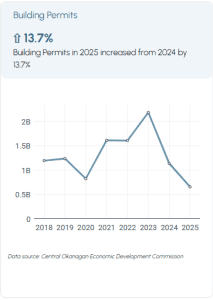
Another key indicator of construction activity in the Central Okanagan is the total value of building permits issued. In Q2 2025, permits totaled $453,937,471, up from $382,201,488 in the same quarter of 2024, marking an 18.8% increase year-over-year (COEDC Data Portal). This growth suggests that while fewer new housing starts are being recorded, the projects moving forward tend to be larger or more complex, potentially reflecting a shift toward multi-family developments commercial builds and institutional builds.. It also indicates that despite higher interest rates and economic uncertainty, investment in the built environment remains strong in key segments of the market.
Increasing Airport Activity
Amid these economic shifts, one indicator continues to rise steadily: airport activity. Kelowna International Airport welcomed 172,674 passengers in Q2 2025, up from 165,003 the year before (COEDC Data Portal). This 4.6% increase reflects a region that remains connected and in demand, whether for tourism, business, or relocation.
In addition to rising passenger numbers, Kelowna International Airport (YLW) expanded its connectivity with several new direct routes during the second quarter. In May, Porter Airlines launched a new service between Kelowna and Toronto Pearson International Airport, starting with five weekly roundtrip flights and increasing to daily service by late June (Kelowna International Airport). These additions not only reflect growing demand but also strengthens Kelowna’s role in connecting local businesses and residents to key economic and travel hubs across Canada and the Pacific Northwest.

Q2 2025 reflects a dynamic period marked by both advancement and pressures. Positive economic indicators such as population growth, sectoral diversification, increased construction investment, and rising mobility underscore the region’s momentum. At the same time, concerns around affordability and employment stability remain central, requiring continued attention and innovative approaches. Overall, the quarter reveals a landscape in transition—facing challenges, yet propelled by emerging opportunities.
To explore more detailed data, economic indicators and insights, visit our data portal.
You Might Also Like...

Economic Indicators Q4 2025
Economic Indicators February 9, 2026

Economic Indicators Q3 2025
COEDC News November 3, 2025

Economic Indicators Q1 2025
Economic Indicators May 20, 2025